By Kristen Oliveri
In a world that never stops scrolling, pinging, and demanding our attention, the most radical act of wealth may simply be learning how to pause.
For this Wealth Reimagined Q&A, I sat down with David Werdiger to explore what it really means to step away, from technology, from constant urgency, and from the noise that so often pulls us away from ourselves and the people we love.
Werdiger brings a rare and deeply relevant perspective to this conversation. As a second-generation family member, a 30-year tech entrepreneur, and the Director of Nathanson Pearson in Melbourne, he has spent decades working with high-net-worth families navigating succession, governance, and the emotional complexity of generational wealth.
A couple of years ago, I wrote up the model in a journal article called “The Time-Purpose Map”.
Q: You’ve written and spoken about the “wealth of time.” How do you define that idea, and why do you believe time can be the truest form of wealth?
A: In business, we think about opportunity cost and marginal benefit. The thing about financial wealth is that the more you have, the marginal value of each dollar goes down. This is especially the case for people who have way more than they or their families could ever need. That means we can reach a point where more money won’t lead to more happiness. Research shows that point – in terms of annual income – is much lower than you might think.
The word “wealth” actually has its roots in the word “wellness”, but these days the connotations are usually financial. Jay Hughes articulated five forms of “family capital”: again, financial capital is the most obvious, but in his framing it’s just there to pay for the other and more important forms of family capital: human, social, intellectual, and spiritual.
So what is true wealth? It’s the stuff that brings “wellness”, and what makes us happy. Again, the research shows that more “things” don’t make us happy. Rather, it’s experiences. And that is how we use our … time!
Q: Many leaders and families feel pressure to always be doing and achieving. How do you help them understand the value of stillness and intentional pauses in their lives and decision-making?
A: People talk about being “asset rich & cash poor”. I talk about being “cash rich & time poor”. I’m as driven as anyone to be doing and achieving, and personally am quite fixated on doing things as efficiently as possible. Yet I’ve found my best thinking and ideation is while taking a walk with thumping music in my ears, or in the shower, sometimes while meditating, or over a long and well-lubricated meal with friends. More isn’t better. The stillness and pauses are part of the natural balance that we need in our lives. Pausing is actually a productivity hack!
Q; Can you tell us about your journey writing this book? What inspired it, and what did the process teach you about your own relationship with time and presence?
A: Wow – how long do we have? I started writing this book after completing a masters and deciding to write a book rather than do a PhD. This was about 15 years ago. The book was originally about the nature of identity in the modern world. I won’t bore you with that now, but if anyone’s interested it’s one of my pet topics. After talking to publishers, I put that whole project on hold and instead wrote Transition, which launched my career as a family enterprise advisor. Once that got traction, I turned my attention back to the original book project. After four pivots, the book became about the world of social media, how it has evolved to become so embedded in our lives, and how it is a silent thief of our most precious resource – our time. It steals time from us so effectively we don’t even notice!
Q: In a world that celebrates productivity and constant connection, how do you personally set boundaries with technology and create space for reflection?
A: For me, observing Sabbath every week does exactly that. From Friday night to Saturday night, I don’t use a phone or a computer, don’t watch TV, and don’t drive. I’ve been doing that my entire life as part of Orthodox Jewish practice, but in recent years it’s taken on a completely new meaning for me in addition to the religious. It used to be restrictive – don’t do this; don’t do that. Now it’s freedom from being tethered to technology. By subtracting that from my life for one day a week, it creates space for reflection and for more meaningful activity. For in-person connection with family and friends that are not interrupted by a buzz in the pocket or a notification on the screen.
Q: What are some small, practical ways that people can begin to “press pause” in their everyday lives, even when they feel too busy to do so?
A: Taking a technology break for one whole day every week is hard for many people. I’m fortunate to have grown up with it. I learned from a young age that when the phone rings, you actually don’t have to answer it. It seems quite obvious when you think about it, but how often do you feel obligated to respond to your phone while in the middle of something else?
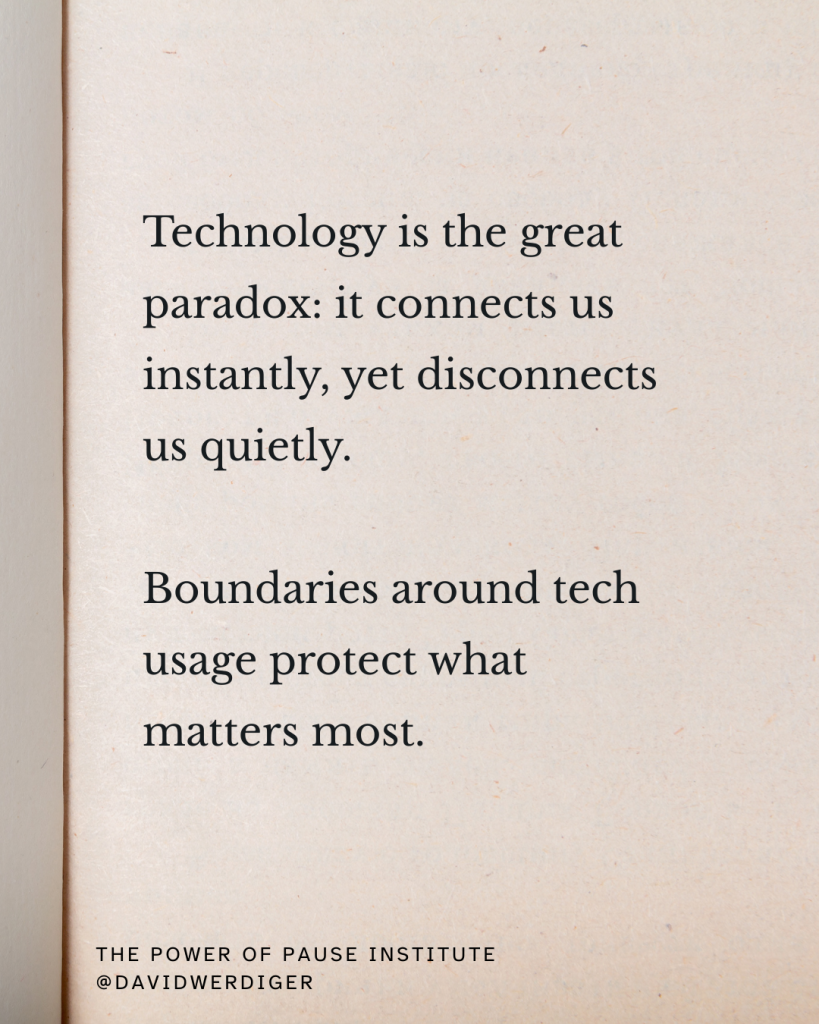
There are many opportunities to “press pause” in everyday life. Whether it’s putting phones away and on silent during meal time, having discipline about phones next to your bed, or even waiting just a few rings before picking up a call. All of these can shift us slowly to respond rather than react to technology. There’s a bit of Steven Covey’s first habit in that: what makes us uniquely human is our ability to pause in between stimulus and response.
Q: You’re also developing a retreat experience around these concepts. What can participants expect, and what do you hope they’ll take away from that time together?
A: As I said, pausing from tech for a whole day once a week is hard for many people. The retreat is a way to experience it fully and learn how to introduce it into your life in a way that will help you. It starts on a Friday at lunch time with discussions about how to prepare for a day of rest and setting your own boundaries. On Friday night we officially switch off and then enjoy a long dinner technology free. That first stage is “passive rest”. On Saturday morning, there are activities like exercise, breakfast with a newspaper, walks in nature, and then a long lunch. That stage is “active rest”. The third state of “transformative rest” is on Saturday afternoon when we consider how the weekly pause from technology can inform a better relationship with technology on the other six days.
A day of rest is not just about respite – you can only really appreciate the impact of tech on your life by stepping back from it. Then on Saturday night, we get our phones and laptops back, and spend time integrating that experience into regular daily life, wrapping things up on Sunday about lunchtime.
Long shared meals with friends and family are such a powerful institution in society, and one that has been chipped away by our busy lives. It’s no surprise those activities are a key part of the retreat experience. We need them in our lives.
Q: Do you think our culture’s relationship with time and technology is changing? Are you seeing more people seek out a slower, more thoughtful pace of life?
A: When I think about productivity, and remembering a time before email and mobile phones, it’s quite staggering how much we are can achieve these days using technology. The ability to communicate anywhere any time, and access almost the entirety of human knowledge from our mobile devices is life changing. It reminds me of the movie Zodiac (2007) about one of the first serial killers in the late 1960s and early ‘70s. Back then, people would stay at home because they were waiting for a phone call, or need to stop at a phone booth to make a call. Today, that seems absurd, but that’s how things were. And I wonder: how on earth could we do everything we do without the help of these devices?
We used to rush home to watch our favourite TV shows, or record them on tapes. In terms of our relationship with time and tech, we were slaves to time. Now, we can access whatever content we want, when we want. Technology has given us a form of mastery over time (but not time travel). But the flip side to the productivity is the pace of life and the challenges of switching off. I think people are struggling with it. They accept that life is better, and live with the unintended consequences of that. Some feel almost trapped. They have an awareness that mobile devices have taken away some of their agency but they don’t see a path out of it.
Q: What does a “wealth of time” look like to you personally? How do you know when you’re living in alignment with that principle?
A: As I said, true “wealth” is “wellness”. It’s not about money; it’s about a sense of wellbeing. In my work with families, I focus on non-financial family capital which is the most important kind. If you have way more money than you need, but you can’t sit at a meal with your family or you have health issues, are you wealthy?
Wealth of time means you are in control of your most precious resource: your time. You are using time intentionally, and it’s serving you, rather than you constantly chasing it. It’s a state of mind as much as a practice. The families who thrive are the ones who reclaim their time, not the ones who work the hardest.
Q: And finally, if there’s one message you’d like readers to remember about the “power of pause”, what would it be?
A: Claude Debussy said, “Music is the space between the notes”. Family leaders who pause, and understand the power of that, create the space for generational alignment, better decisions, and stronger relationships.
This article is originally posted at Wealth Reimagine.